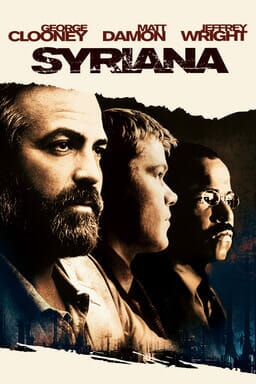
- George Clooney
- Matt Damon
- Jeffrey Wright
Syriana
Everything is Connected
“We are living in complex, difficult times and I wanted Syriana to reflect this complexity in a visceral way, to embrace it narratively. There are no good guys and no bad guys and there are no easy answers. The characters do not have traditional character arcs; the stories don’t wrap up in neat little life lessons, the questions remain open. The hope was that by not wrapping everything up, the film will get under your skin in a different way and stay with you longer. This seemed like the most honest reflection of this post 9-11 world we all find ourselves in.”
- Stephen Gaghan
Syriana was written and directed by Stephen Gaghan, winner of the Academy Award for Best Screenplay for Traffic. Gaghan started thinking about the machinations of the global oil industry while doing research for that earlier film. He had met a host of powerful people in Washington, including those at the Pentagon who enforce America’s anti-narcotics policies. It was then that he began noticing some interesting parallels between the trafficking of drugs and the power plays of the oil industry.
“At that time,” says Gaghan, “the Pentagon’s anti-terrorism and anti-narcotics branches were the same branch. And I started thinking that maybe the biggest addiction in our country is how we’re hooked on cheap foreign oil. And that our easy access to oil is what gives us a good deal of our edge.”
When Traffic director Steven Soderbergh, actor/producer George Clooney and their production company, Section Eight, introduced Gaghan to See No Evil, a memoir written by former CIA agent Robert Baer, it was a perfect way for Gaghan to develop this interest. The book chronicles Baer’s experiences working out of the Middle East as a case officer for the Central Intelligence Agency’s Directorate of Operations from 1976 to 1997. “Steve Gaghan once said to me that he thought oil was the world’s crack addiction,” says Soderbergh, “and I knew he would find a novel way of exploring that idea.”
While the book provided the initial impetus for Syriana, Baer’s experiences as a CIA field officer are what really served as a jumping-off point for the broader story that the filmmakers wanted to tell. “The book itself was fascinating,” says Clooney, “and the more time we spent with it, the more we discovered there was actually another story to be told beyond the one in the book. We saw the potential for Syriana to be made in the fashion of the films of the mid-60s and early 70s that were willing to discuss the failures of government as if they were failures of all of us, not just a particular party or group.”
“I think what we’ve done is preserve the essence of Bob, even though his storyline is fictional,” Gaghan says. “He also helped me understand the web of players in the Middle East and in the oil business that ultimately led to the choice to tell this story through multiple narratives.”
Gaghan researched the film for a year before beginning work on the screenplay, investigating the inner workings of the industry in the United States, as well as journeying to the UK, France, Italy, Switzerland, Lebanon, Syria, Dubai, and North Africa to speak with people at every level of the power chain that makes up the petroleum industry.
Bob Baer himself took Gaghan to explore the regions of the Middle East where he worked gathering intelligence for 21 years, introducing the director to a multitude of figures that exist on all sides of the industry, including oil traders, CIA operatives, arms dealers, and the leader of the Islamic movement Hezbollah. “I discovered really hospitable people with very articulate points of view,” says Gaghan of his travels. “I found that if you ask the same question to five different people, you get five different stories – and it’s still not the whole story. Starting from there, I tried to focus in on how this whole world of clandestine information worked.”
After his intensive travel and study, Gaghan began work on the screenplay, in which he would weave together multiple independent storylines that illuminate the inner workings of the industry and the figures who keep it running, whether through the wielding of their considerable influence, the force of their will or the exploitation of their labor.
The filmmakers’ chief intent was to tell a compelling story that also reflected the complexity and ambiguity of our current situation – one that that explores diverse points of view, while not championing any one perspective as the truth. “We’re not trying to preach to anyone with this film,” says Clooney. “Movies, at their best, can initiate discussions – obviously, in this case, discussions about world dependency on oil, but Syriana also opens discussions about corruption, about the effectiveness of the CIA, about any number of things. You want people to be standing around the water cooler the next day talking about it, saying here’s what I agree with or here’s where they’re wrong. We need that discussion.”
Gaghan also hopes Syriana will make issues and characters that seem alien and distant to American audiences much more accessible. “Any time the lens by which you’re viewing the whole can also be the lens by which you view the specific, you’re in better shape,” says Gaghan. “We’re able to go from Wasim, working with his father in the Persian Gulf, where he says, someday we’ll get a real house and get your mother here, to Robby Barnes visiting a college campus with his dad, Bob. The power of those specific images next to each other is that you hopefully start to feel connections that show you the whole: how we all inhabit the same world, and we all just want better lives for our children.
“This movie uses ordinary people in extraordinary circumstances to explore the idea that personal responsibility does matter, that our daily choices contributes to where we are on a global level,” continues Gaghan. “Bob Barnes is ultimately a company man who’s trying to do his job well and put his son through college. Bryan Woodman’s got a wife and two children, and then he faces the worst thing a father can go through when he loses his son. Bennett Holiday has a very difficult relationship with his father, so he’s trying to deal with these complicated issues in his work while also holding it together at home – which is a situation we all find ourselves in. So it’s through these characters’ everyday lives that we’re able to enter into a world that at first blush seems abstract to most people, but is incredibly relevant because this nexus of oil interests, terrorism, and the possibility of democracy in the Middle East powerfully affects our economy as well as our psyche and will continue to do so for the foreseeable future.
“While ‘Syriana’ is a very real term used by Washington think-tanks to describe a hypothetical reshaping of the Middle East, as our title it is used more abstractly. ‘Syriana,’ the concept – the fallacious dream that you can successfully remake nation-states in your own image – is a mirage. Syriana is a fitting title for a film that could exist at any time and be about any set of circumstances that deal with man’s unchecked ambition, hubris, and the fantasy of empire.”